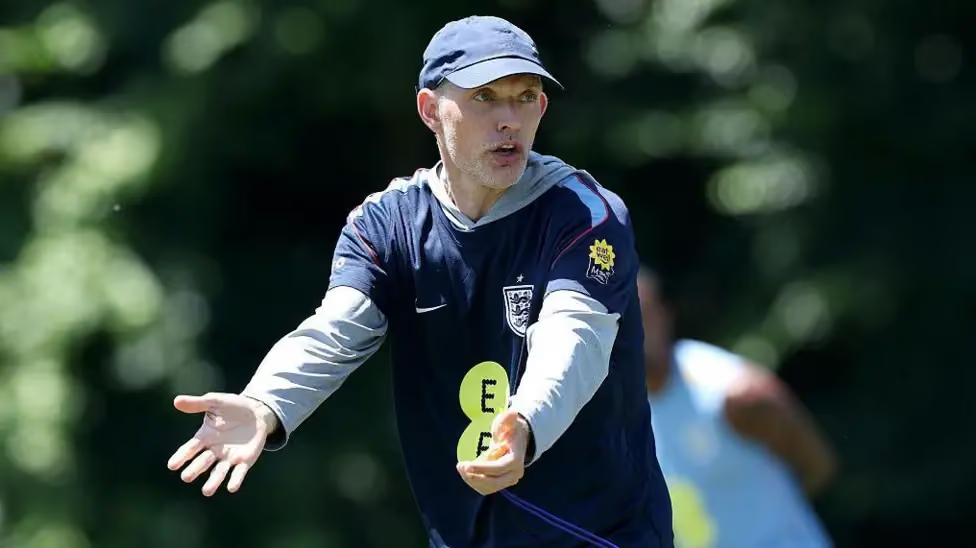
"If we lose, we lose in our way"
Those were the words Thomas Tuchel shared with his England team at half time in the World Cup match with Croatia last night. And it worked. The team went from drawing 2-2 to winning the match 4-2.
That isn't talent. It's a methodology. One playing identity, written down, and cascaded through every age group and every coach in the building.
Now look at most clubs. The U10s play one way because their coach loves possession. The U14s play another because their coach was a centre-back. The seniors do whatever the current manager picked up last season. Three teams, three philosophies, one badge. When a coach leaves, their way of playing leaves with them - and the next volunteer starts again from scratch.
This is the gap between the clubs on your screen and the club on your doorstep. And it's a gap you can close without a federation's budget.
Why a shared identity matters more than you think
The instinct is to file "playing philosophy" under nice to have - something for academies and pro clubs, not for a semi-pro side or a community club run on evenings and goodwill. The numbers say otherwise.
Players leave the game in droves as they get older. A study tracking adolescent footballers found a dropout rate above 50% over four years among 16–21 year-olds. In the US, retention data shows a steep cliff at the older age groups - second-year return rates falling to around 52% by U17 for both boys and girls. In Australia, research from 2024 found that a quarter of young people had decided to stop playing sport by age 15, with cost, time and competitiveness driving the exits.
Not all of that is in a club's control. Teenagers get jobs, exams and other interests. But a meaningful slice of it is about experience - and experience is exactly what a shared identity protects. When a player moves up an age group and everything changes - the style, the language, the expectations — the game starts to feel like a series of disconnected seasons. When they move up and the principles stay familiar, progress feels continuous. They know what's being asked. They can see themselves getting better at a recognisable thing.
There's a coaching side to this too. Volunteer coaching is under strain everywhere. Formal volunteering in the US fell to 23.2% between 2019 and 2021 - the largest drop the Census Bureau had recorded since it began tracking in 2002 - and youth sport felt it. When coaches turn over and nothing is written down, every departure resets the club. A methodology is what lets a new coach walk in and pick up where the last one left off, instead of reinventing the U12s from memory.
A shared identity, then, isn't decoration. It's the thing that makes development continuous for players and survivable for clubs.
What a club identity actually looks like
It's simpler than the phrase suggests. You don't need a 40-page coaching manual. You need a small number of clear decisions that everyone in the club can name and teach.
Playing principles. How do you want to play, in and out of possession? Four or five plain statements. Not "we play like Barcelona" - something a U9 coach and a senior coach can both act on. We build from the back when we can. We press as a unit. We move the ball forward with intent.
Age-group translation. What does each principle look like at U8 versus U14 versus seniors? "Press as a unit" means something different to a seven-year-old than to a 17-year-old. Spelling that out is what turns a nice idea into something coachable on a wet Tuesday.
Non-negotiables. The handful of things every team does the same, regardless of level or result. This is the spine of the identity - the part that doesn't bend to the next coach's preferences.
Session alignment. How does a normal training session reflect all of the above? One worked example does more than a page of theory.
Coach onboarding. The one page a new or departing coach hands over, so the identity survives a change of staff instead of leaving with them.
That's it. Five decisions, written down, shared. The hard part was never the format - it's making the decisions and keeping them alive across a whole club season after season.
And when the paper starts to creak
Here's the honest part. Filling out a blueprint by hand is the right first step - but keeping it alive is where most clubs come unstuck. The document sits in a folder. The age-group translations don't make it into actual sessions. A new coach never reads the onboarding page. Within a season, the identity is back in one person's head.
That's the problem Coachbetter's Performance OS is built to solve. You write your methodology once, and it cascades automatically - every age group, every coach, every session plan inheriting the same principles. When a coach leaves, the methodology stays with the club, not in their notebook.
Book a short demo today and we'll show you what your identity looks like when the platform keeps it alive for you.