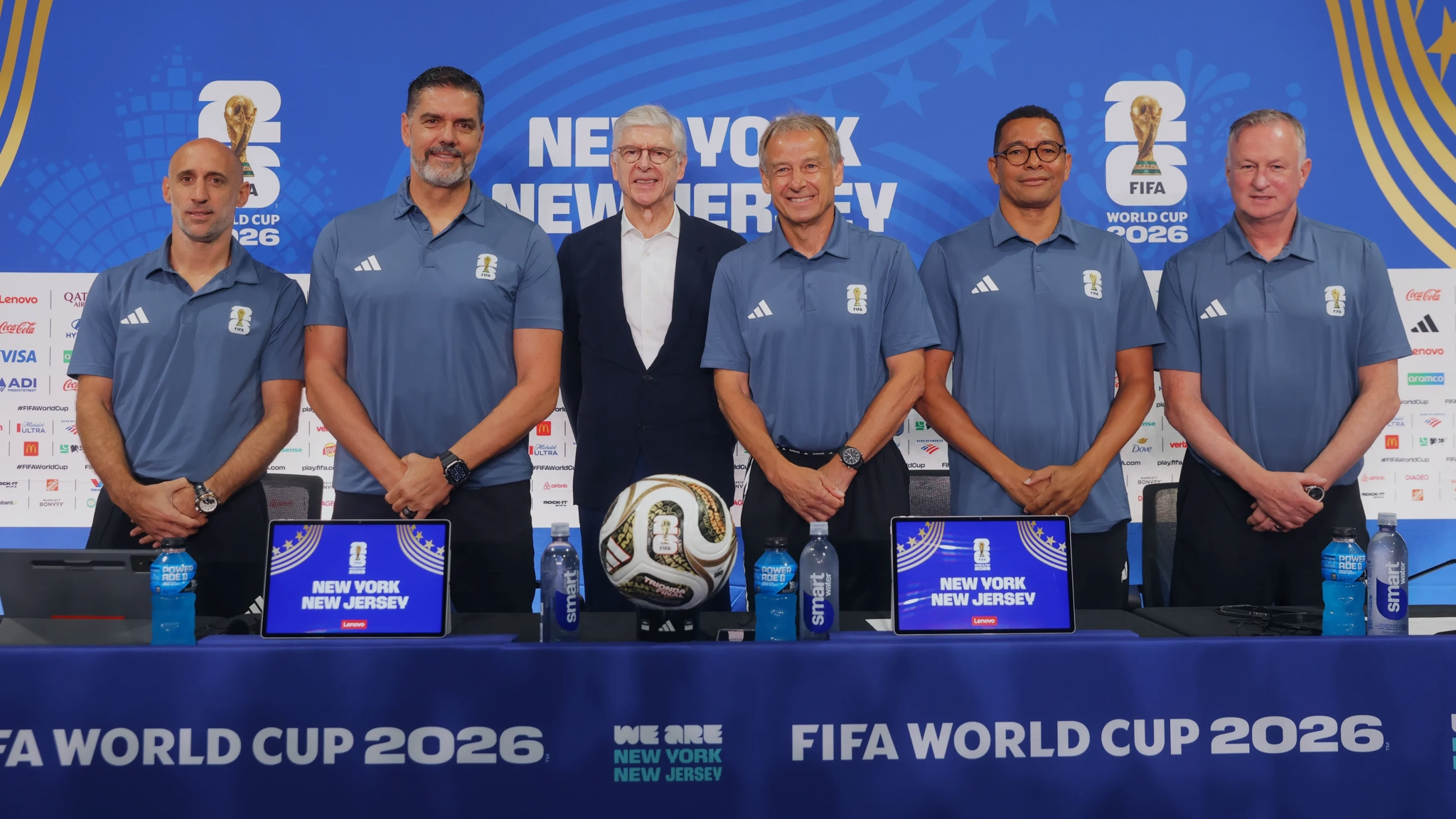
The day before the Spain–Argentina final, FIFA's Technical Study Group — Arsène Wenger, Jürgen Klinsmann, Gilberto Silva, Pablo Zabaleta, Michael O'Neill, and former Swiss international goalkeeper Pascal Zuberbühler — briefed the media on a month of tracking data across the first 48-team World Cup.
Their verdict: the tournament worked.
But that's not the useful part. The useful part is what the numbers say about how the game is actually being coached right now, at the highest level it will ever be played. Here's what it means for the session you're running Tuesday night.
1. The rules changed, and the cheating disappeared with them
Before the tournament, FIFA adjusted two laws: how long a goal kick can take before the game restarts, and the requirement that a player receiving on-field medical attention leave the pitch for a minute. The data shows both did exactly what they were designed to do. Goal kicks over 30 seconds dropped from more than a quarter of all goal kicks to 12%. On-pitch medical interventions fell from an average of 2.3 per game to 1.6.
Wenger made the more interesting point, though: the real impact isn't in either number. It's the part you can't measure. "The frustration you feel when somebody lies on the pitch and is not injured" — that feeling, he said, is simply gone from this tournament, and everyone he asked noticed it without being prompted.
That's a rule change doing a coaching job. It didn't just speed up restarts; it removed an incentive to cheat the game, and the players adjusted their behavior because the loophole closed.
For youth coaches: time-wasting and fake injuries are learned behaviors, not personality traits. Players do them because they work and nobody corrects them. Close the loophole yourself — call it out, coach it out — and you don't need a law change to get the same result.
2. Goalkeepers are built brave — starting at age 5
Goalkeepers are punching the ball more than they used to: up from 0.47 to 0.59 attempts per 60 minutes, and specifically up over 8% on punches from corners. Tom Gardner, FIFA's lead on performance insights, was clear this isn't just a byproduct of more crosses coming in — it's a deliberate shift in how goalkeepers are choosing to intervene.
Zuberbühler, a goalkeeper himself, explained why: coming for a cross takes bravery, timing, and scanning the space before the ball arrives, and this tournament's goalkeepers did all three better than in his own playing days. Crucially, he tied it to training age, not talent — the X-block save technique, the one where the goalkeeper spreads arms and legs like a spider to block at close range, "you start already at 5 years old in the youth team." He pointed to Emiliano Martínez's iconic X-block save in the 2022 final shootout as the payoff of exactly that kind of repetition, started years earlier.
He also made a point about partnership: a goalkeeper coming off his line only works if his defenders aren't in the way — punching a teammate instead of the ball is the risk. Defenders and goalkeepers have to train that timing together, not separately.
For youth coaches: goalkeeping isn't the position you hand to whoever's left over, and it isn't a set of instincts kids either have or don't. Shape, timing, and the confidence to come off the line are technical skills with a training age, and Zuberbühler's answer for when that training should start is blunt: now, at 5.
3. The low block became a launchpad, not just a wall
The clearest tactical shift in the whole tournament: time spent in a low block rose from 21% to 25% of out-of-possession play — roughly three to five extra minutes a match — and it came directly out of the mid-block, which nearly disappeared. Teams stopped defending from the halfway line and dropped deep instead.
On its own, that sounds like a more cautious, more defensive World Cup. It wasn't. The teams who went furthest — Spain, France, Argentina — didn't just sit in the low block, they used it as a launchpad. Ten players compact and close to their own goal, then the moment the ball turns over, a fast, direct break the other way before the opponent can reorganize. Wenger was clear on the trade-off: a low block shortens the distance to your own goalkeeper, but it also puts you further from the opponent's — and if you can't transition out of it quickly, you get stuck there. Morocco against France was the cautionary tale: a team dangerous enough to hurt France, dropped so deep it never found a way back out, and paid for it.
That same defensive compactness is also why shots from distance suddenly mattered. Attempts from outside the box barely changed between tournaments, but goals scored from there doubled — 8% to 16% — simply because packed low blocks left nothing to work with inside the 18-yard box.
For youth coaches: don't just teach the low block as "get behind the ball." Teach it as a platform with a job to do the instant possession changes — where players run, who breaks first, how quickly you go from ten behind the ball to a three-on-two the other way. And build the shooting confidence to punish a crowded box from distance, because your players will see stacked defenses long before they ever reach a pro pitch.
4. Pressing is a shape now, not a sprint
In Qatar, high pressing was mostly one striker as the trigger, chasing the ball with the rest of the team reacting behind him. FIFA's positional data shows that's changed: teams now press with two strikers together, most often forming something close to a 4-4-2, positioned either side of the top of the box. It's a visibly different picture on the tracking maps — two focal points instead of one central one.
It's also working. Teams are forcing more long, unwanted distributions out of opponents trying to play from the back, and making more tackles, blocks, and interceptions while the opponent tries to build. Wenger added the coaching detail underneath the shape: it isn't two pure strikers, it's one fixed presser and one flexible forward willing to drop into midfield the moment the first line gets played through — without that, you're outnumbered in the center against a team like Spain. Michael O'Neill made the complementary point: the 4-4-2 protects the middle of the pitch while still covering it fully, and having four defenders behind it means you can also win the ball back high after forcing a long pass over the top.
For youth coaches: "press harder" isn't a tactic, it's an instruction with no shape behind it. Pressing is a team structure with defined roles — including one player who knows when to stop pressing and start covering midfield — and every part of that is teachable well before players are old or fit enough to sprint for 90 minutes.
5. Speed beats mileage
Total physical output — distance covered, normalized per 90 minutes — was essentially flat between 2022 and 2026. Klinsmann's explanation: teams are defending more efficiently now, spending less energy doing it, which offsets any extra demand from a longer, more spread-out tournament. One number did move, though: average max speed rose by eight-tenths of a kilometer per hour, a figure that sounds small until you consider what a fraction of a second of extra top speed does in a one-on-one race.
Wenger pushed back on reading too much into the flat distance number. In his view, it doesn't reflect what he actually saw on the pitch: teams more compact and organized than ever, covering similar ground but doing it through sharper, more explosive movements rather than sheer volume. He pointed to the tournament's early Asian exits as evidence — not a fitness gap, an explosiveness gap. Klinsmann agreed the difference-maker now is speed, and that it's built at club level over years, not added during a five-and-a-half-week tournament window — which is also, he noted, why there was so little time for coaches to train new set-piece variations this cycle.
For youth coaches: if your physical program is built around running more, you're training the wrong output. Short, sharp speed work and change-of-direction training is what separates players at the top now — build for explosiveness, not just fitness, and start earlier than you think you need to.
6. The team beats the talent
Wenger traced this idea back to FIFA's under-17 World Cup, also expanded to 48 teams the year before: over a longer, harder competition, the teams who reached the final weren't the most talented individually, they were simply more of a team than anyone else left in the draw. He said the same pattern repeated here. Argentina got through Cabo Verde, Egypt, and England — all difficult, resistant opponents — and Zabaleta's explanation was continuity: this Argentina squad has played together for four or five years, and it shows in how they manipulate space to find Messi between the lines.
Spain won the same way through a different route — a style built on technical quality and team intelligence rather than individual moments, with players rotating and pressing as a unit rather than relying on one match-winner. Wenger's read on the final pairing: one team with more of a mental edge, one with more of a technical edge, but both proving the same underlying point — organized, connected teams are now beating teams built around isolated talent.
For youth coaches: your biggest lever isn't your most gifted individual player. It's how long you keep a group training and playing together, learning to read each other, before you break it up chasing the next trial or the next age-group reshuffle.
None of this is complicated. Six small corrections — to coaching, to training design, to what you reward in your own session. None of them came from outspending anyone. They came from time on task: years of the same group training the same principles until they became instinct.
Build the habits now. The World Cup just told you which ones matter.